
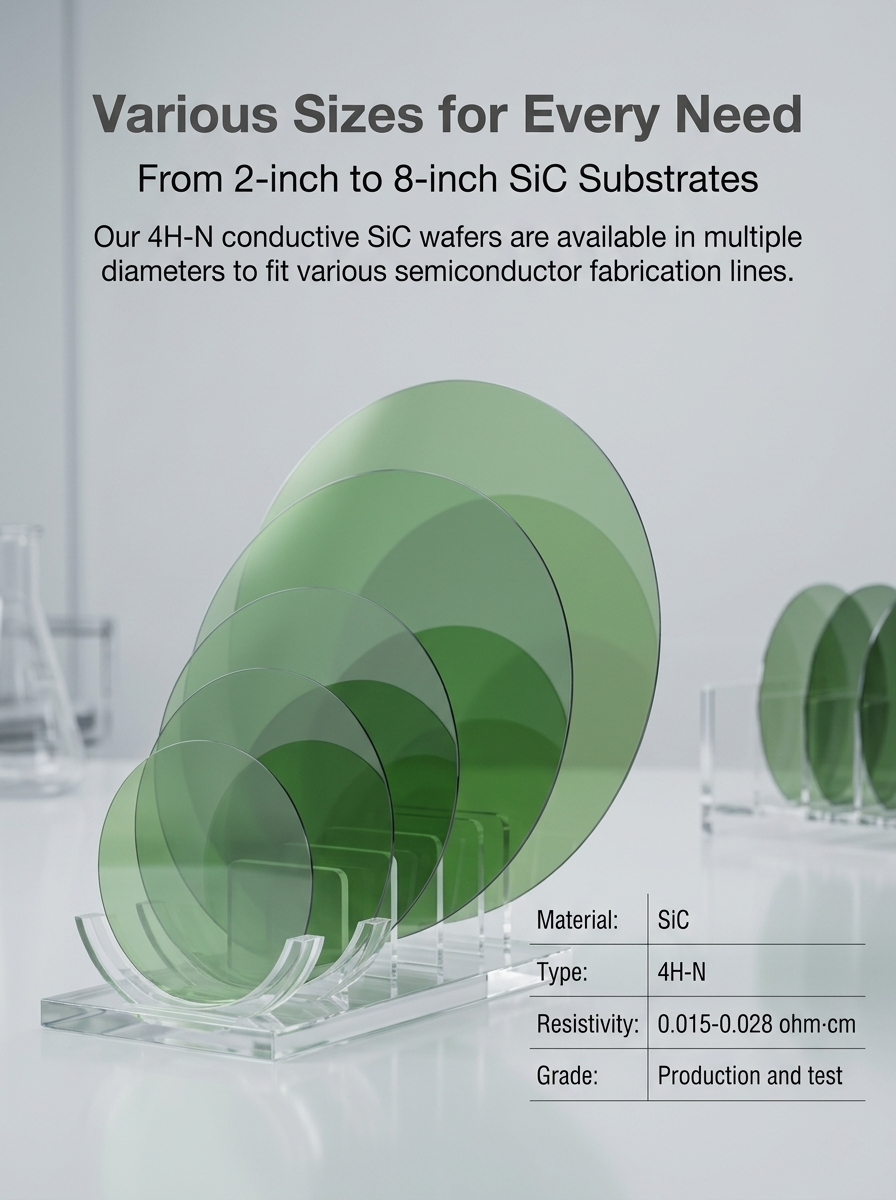
As a professional SiC wafer manufacturers, we provide 2 inch to 8 inch 4H polytype SiC wafers in both conductive and semi-insulating types – ideal for high-voltage, high-efficiency power applications. The core advantage of silicon carbide (SiC) can be summed up in one sentence: To withstand the same 1200V voltage, an SiC device requires only one-tenth the thickness of a silicon device. This physical property triggers a chain reaction: 10x thinner → tens of times lower resistance → more than 50% less heat → 2-5 percentage points higher efficiency. This gap cannot be closed by process optimization – it is determined by the physical limits of the materials at the atomic level.
SiC’s breakdown electric field is nearly 10 times that of silicon (2.8 vs 0.3 MV/cm), meaning it can withstand much higher voltage stress. Therefore, at the same voltage, SiC devices can be made thinner, with higher doping concentration, and naturally lower resistance. Using the Baliga figure of merit (BFOM), SiC’s theoretical performance limit is 440 times that of silicon – this is not a “one or two generations ahead” concept, but an overwhelming advantage rooted in the laws of physics.
 Where Does SiC Demand Come From?
1: New Energy Vehicles (Largest Market Today)
In 2025, SiC main-drive inverter penetration in China’s new energy passenger vehicles has exceeded 30%, and among 800V high-voltage platform models, penetration reaches 76%. The Tesla Model 3 shows a real-world range improvement of 5-8% – equivalent to “free 5 kWh of battery” – while also reducing battery charge/discharge cycles and extending battery life. Note, however, that a car runs only about 2 hours a day. The economics of SiC in automotive mainly come from “reducing battery size” and “enhancing brand competitiveness”; the pure electricity bill savings are not dramatic.
2: AI Data Centers (Fastest Growing, Largest Headroom)
This is the most promising direction, with clear logic:
GPU power surge: A100 (400W) → H100 (700W) → B200 (1000W); next generation expected 1500W+.
Always-on operation: 8,760 hours/year – 12 times that of a car.
Voltage step-up: Traditional 380V AC → next-gen 800V HVDC, right in SiC’s sweet spot.
Massive scale: Single hyperscale data center 100MW+; hundreds under construction globally.
Judgment: By 2030, AI data centers are likely to surpass EVs as the largest single market for SiC. Why? Because data centers are extremely sensitive to efficiency (electricity cost accounts for 30-50% of operating costs), and they run 24/7 – every watt saved by SiC works all day, every day.
3: Solar PV + Energy Storage (Steady Growth)
PV inverter efficiency improves from 97-98% to 99%+. For a 100kW inverter, every 1% efficiency gain generates an additional 35,000 kWh over 25 years. Among 200kW+ string inverters, SiC adoption has exceeded 50%.
Today, SiC device cost is 3-5x that of silicon, limiting penetration in low-to-mid power segments. With 8-inch mass production + yield improvement + equipment localization, cost is expected to fall to within 1.5x that of silicon. At that point, penetration will expand from high-end vehicles to mainstream models, and from large inverters to small‑ and medium‑sized ones.
SiC replacing silicon is not a story that “might happen” – it is a story that “must happen, as dictated by the laws of physics.” The only question is who gets the biggest piece of the pie, and when.
 E-mail: kim@homray-material.com;tina@homray-material.com
HMT Silicon Carbide (SiC) Wafer Website: www.sicwafer-hmt.com