
Major technology companies are successively entering the AR glasses market, which is expected to accelerate the industrialization of AR glasses with silicon carbide (SiC) waveguides.This growing demand will also create significant opportunities for upstream SiC substrate manufacturers, who are crucial for producing the core optical material. HMT produce 6inch 8inch semi-insulating optic SiC Substrate for AR AI applications.
Global AR glasses shipments reached 553,000 units in 2024, a year-on-year increase of 7.8%. Among these, China shipped 286,000 units in 2024. The Chinese AR glasses market experienced a peak in development in 2024, with more brands and new products entering the market. AR glasses have also shown significant improvements in portability, lightweight design, functionality, and technology, better meeting consumer demands. It is projected that shipments could exceed 2.95 million units by 2028.
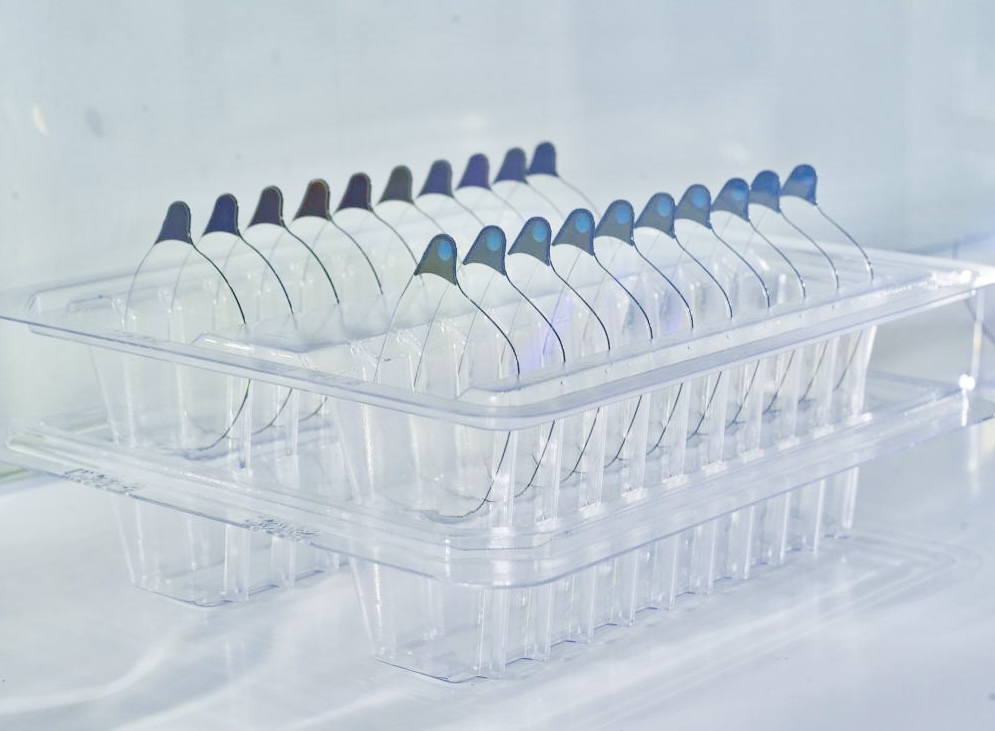 The high refractive index of SiC allows the grating period to be designed very small. A small grating period increases the diffraction angle of ambient light, which, when it exceeds the observable range of the human eye, resolves the rainbow pattern phenomenon caused by light splitting. The rainbow pattern refers to the dispersion phenomenon where white light turns into rainbow-colored light after passing through the AR waveguide, essentially caused by the difference in diffraction angles of the grating for light of different wavelengths (colors). The high refractive index of SiC material can compress the effective wavelength of light within the material, thereby reducing the grating period. As the grating period decreases, the difference in dispersion angles for different colors of light at a fixed incident angle decreases, reducing color separation. From a process feasibility perspective, the hardness and chemical stability of silicon carbide support nanoimprint and electron-beam lithography processes, enabling high-precision processing of submicron grating periods in engineering, thus resolving the rainbow pattern phenomenon. Experimental Data: Compared to a glass substrate (grating period = 500nm), a diffraction waveguide using a silicon carbide substrate (grating period = 300nm) reduces the difference in dispersion angles by about 40% in the visible light spectrum (400-700nm), and the subjective perception intensity of the rainbow pattern decreases by over 60%.
Silicon Carbide Material: High Thermal Conductivity Ensures Performance Stability and Enables Lightweight Design for AR Glasses
The thermal conductivity of silicon carbide (about 490 W/m·K) is far higher than that of traditional optical materials such as glass (about 1 W/m·K) and resin. This allows it to quickly conduct heat generated by the optical engine module and computing unit, preventing performance degradation or device damage caused by localized overheating. For example, traditional AR glasses often trigger overheating protection mechanisms due to heat from the optical engine, leading to reduced brightness and refresh rates. In contrast, silicon carbide waveguide sheets significantly reduce the risk of heat accumulation through the material's own high-efficiency thermal conduction, thereby supporting high-brightness displays (such as a peak brightness of 5000 nits) and long-term stable operation.
The high thermal conductivity of silicon carbide material simplifies the thermal design of AR glasses, enabling lightweight designs. Traditional AR glasses rely on heat dissipation modules in the temples or active cooling systems, increasing device weight and complexity. The high thermal conductivity of silicon carbide allows the heat dissipation function to be integrated into the optical waveguide sheet itself, meeting requirements through passive heat dissipation. Additionally, excellent heat dissipation performance provides redundancy for enhancing the integration of AR glasses and configuring more sensors.
 E-mail: kim@homray-material.com;tina@homray-material.com
HMT Silicon Carbide (SiC) Wafer Website: www.sicwafer-hmt.com