
Silicon Carbide: The Third-Generation Wide-Bandgap Semiconductor Material,HMT foucs on providing 2inch to 8inch 4H-SiC materials,like SiC Wafer, SiC Epitaxy Wafer and SiC Boules with very competitve price.
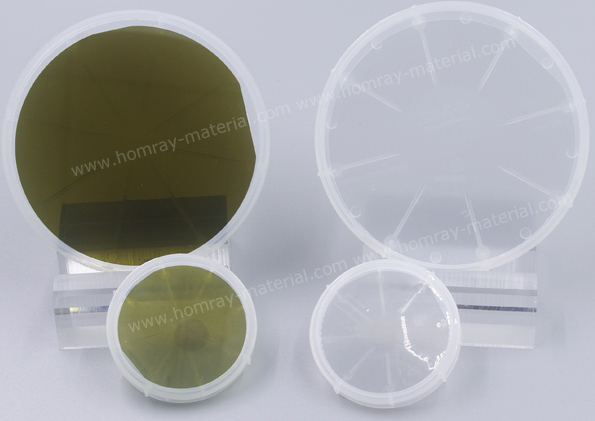 Think of it as the "special forces" of the semiconductor world. Compared to traditional silicon (Si), it boasts three core advantages:
-
High Voltage Resistance: Its breakdown electric field strength is 10 times that of silicon.
-
High Temperature Tolerance: It can theoretically operate at temperatures above 600°C, whereas silicon begins to degrade beyond 175°C.
-
High-Frequency & High Efficiency: Electrons migrate faster in
SiC, resulting in extremely low switching losses.
Let's delve into how this "dark horse" material plays a critical role in various cutting-edge technological fields.
1. Optical Applications: e.g., AR Glasses
-
Principle: AR glasses require seamless fusion of digital information with the real world, demanding extremely high brightness, contrast ratio, and pixel density from display technology. Micro-LED is considered the ultimate display solution for AR glasses.
-
How SiC Contributes:
Ideal Substrate: Manufacturing high-performance Gallium Nitride (GaN)-based Micro- LED chips requires a perfect "foundation." SiC's lattice constant and thermal expansion coefficient closely match those of GaN, making it the optimal substrate material for producing high-brightness, high-resolution GaN Micro-LEDs.
Performance Enhancement: GaN Micro-LEDs grown on SiC substrates exhibit lower defect density, higher luminous efficiency, and longer lifespan. This translates to AR glasses that are brighter, sharper, more energy-efficient, and more compact. -
Summary: In AR glasses, SiC doesn't emit light directly but acts as the "foundation of the crown," enabling and empowering the top-tier Micro-LED display technology.
2. Medical Equipment
-
Principle: Medical equipment (e.g., CT, MRI, X-ray machines, portable ultrasound) demands extremely high power density, precision, and reliability.
-
How SiC Contributes:
High Power Density: SiC devices allow power supplies and motor drive systems in medical equipment to operate at higher frequencies, significantly reducing the size of passive components like transformers and inductors. This enables greater miniaturization and portability.
High Precision & Low Noise: The fast switching speed of SiC devices generates less noise, which is crucial for equipment capturing weak biological signals (e.g., ultrasound imaging), resulting in clearer, more accurate images.
High Reliability: In harsh environments with high temperatures and high power (e.g., rotating components in CT scanners), SiC's high-temperature tolerance ensures long-term stable operation and reduced failure rates. -
Summary: In medical equipment, SiC is the unsung hero enhancing performance, portability, and reliability.
3. Artificial Intelligence & Robotics: AI Thermal Management
-
Principle: The more powerful the "brain" of AI robots (e.g., GPUs, ASICs), the greater the power consumption and heat generation. Heat dissipation has become a bottleneck limiting their performance.
-
How SiC Contributes:
Clarification: It's not used as a heat sink. A common misconception is that SiC itself is used as cooling fins. Instead, SiC leverages its superior semiconductor properties to reduce heat generation at the source.
Reducing Energy Conversion Losses: Power supplies (PSUs) and voltage regulator modules (VRMs) in AI servers extensively use SiC power devices. Due to SiC's extremely low switching and conduction losses, energy loss (dissipated as heat) is significantly reduced during AC-DC and DC-DC conversion. This means the power delivery system itself generates less heat.
Indirectly Aiding Cooling: Reduced heat from the power system lowers the overall thermal load, allowing the cooling system to focus more on cooling the AI compute chips themselves, ensuring sustained peak performance. -
Summary: In AI thermal management, SiC acts as an "efficiency master," minimizing waste heat generation through highly efficient power conversion, indirectly safeguarding the "cool" operation of AI chips.
 E-mail: kim@homray-material.com;tina@homray-material.com
HMT Silicon Carbide (SiC) Wafer Website: www.sicwafer-hmt.com